What Is a Computational Load Entity?
By Keirsten Brager
A large AI data center used to be just a customer of the grid. On July 16, 2026, FERC changed that, directing NERC to create the Computational Load Entity, a new class of registered entity subject to mandatory federal reliability standards. A plain-English guide to what the category is and why it exists, and the anchor for the AI Reliability Boundary series. Engage with this post on LinkedIn.
Overview
Until now, a large AI data center was a customer of the grid. A very big one, but a customer, no different in the grid's eyes from a factory or a shopping mall. On July 16, 2026, that changed. FERC directed NERC to create an entirely new class of registered entity, the Computational Load Entity, that could place some of these facilities under mandatory federal reliability standards for the first time. The trigger is not subtle: the explosive growth of AI computing has produced electric loads unlike anything the reliability framework was built to manage.
If you run one of these facilities, or you are the utility that serves it, this is the category that will define your reliability obligations as the standards are written over the next two years and phased in after that. This is also the first piece in the AI Reliability Boundary series, which follows where AI operations meet mandatory electric reliability regulation. Here is what the new category is, in plain terms, and why it exists.
A little history makes the shift clear. The grid's functional roles are about a century old: the companies that generate power, the ones that move it across high-voltage lines, the ones that keep supply and demand in balance second by second. The list that binds them to federal rules is newer. Reliability compliance was voluntary until 2007, when the first enforceable standards and a registry of these entities took effect. Data centers were never on it.
What is a Computational Load Entity?
Start with the load. FERC defines computational load as power demand from information technology equipment such as servers, storage, and networking hardware. In practice that means AI training clusters, cloud data centers, and crypto mining facilities. A Computational Load Entity is the company that owns or operates enough of that load to be placed on NERC's compliance registry, alongside the generators and transmission owners already there.
How much is enough? NERC has proposed a specific line. Under its draft registration criteria, you become a Computational Load Entity if you host at least 1 MW of information-technology load as part of an aggregate connection of 20 MW or more, at a single point of interconnection at 60 kV or above. Those numbers are a proposal, not yet the final rule. FERC's July order directs NERC to finalize the registry criteria by December 31, 2026, so the exact threshold can still shift. But the shape is clear: this is aimed at large, transmission-connected computing facilities, not the server closet down the hall.
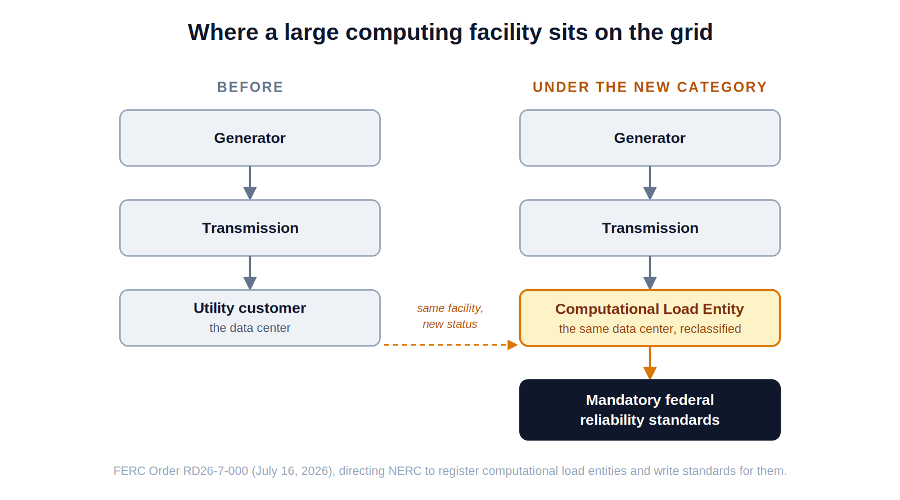
The same facility, a new status. FERC’s order moves large computing loads from the customer side of the meter to the registry side.
Why does the grid need a new category for data centers?
These loads behave nothing like the industrial loads planners have modeled for decades. They are power electronics running under software control, and they can move faster than any operator can react.
Start with speed. NERC's white paper on emerging large loads documents an AI training facility whose demand swung at 1.9 per unit per second, a spike that lasted about 250 milliseconds at the start of a training run. A separate case in the same paper shows a data center sliding from roughly 450 MW to 40 MW over 36 seconds. Two different events on two different timescales, and neither one behaves like the steady industrial load planners are used to.
Then there is reactive power. Many of these facilities push it onto the system instead of drawing it, which quietly overstates everyone's stability margin and leaves the grid running closer to the edge than the models show.
Finally, protection. These facilities are wired to guard themselves, not the grid. During an ordinary fault, thousands of megawatts can trip offline at once and wait to come back, and that is exactly when the grid can least afford to lose them.
None of this is hypothetical. On July 10, 2024, a single fault in the Eastern Interconnection led to the near-simultaneous loss of roughly 1,500 MW of data center load in seconds. No operator asked for it, and no study had modeled it.
It was not a one-off. A NERC incident review counted 26 ride-through events in ERCOT between January 2023 and September 2025 in which crypto facilities shed anywhere from 17 to 95 percent of their consumption within milliseconds of a voltage disturbance. NERC's 2026 State of Reliability report named these loads a growing source of frequency and voltage instability. FERC read that record and decided the grid could no longer treat these facilities as ordinary customers.
What does "Registered Entity" actually mean?
This is the part that changes the stakes. Being a customer means you have a contract with your utility. Being a registered entity means you have obligations under federal law.
Once a facility is on the NERC compliance registry, it becomes subject to mandatory Reliability Standards. Those standards are enforceable, and violations can carry penalties north of $1.5 million per day, per violation, a ceiling that is adjusted for inflation every year. The obligations under discussion for Computational Load Entities include coordinating with grid operators in real time, following operating instructions, meeting ride-through requirements so a facility stays connected through a disturbance, and meeting ramp-rate limits so it cannot slam the system.
None of this arrives overnight. Reliability Standards phase in, with enforcement dates set years after approval to give entities time to build the capability the standards demand: the monitoring and telemetry to see the load, the protection and control upgrades to manage it, the model validation to study it, and the compliance and governance programs to sustain all of it. The direction, though, is fixed. A relationship that used to live entirely in a private interconnection agreement is becoming a federal compliance obligation that an auditor can read.
Why this is a risk and capital question
Registration turns this from an engineering issue into a governance issue. Once an organization is a registered entity, executive accountability, compliance oversight, cybersecurity investment, and audit readiness all become board-level concerns. It also moves real money, along four lines any executive will recognize.
Reliability risk, today. A preventable event driven by computational load can draw a prudency review, where the resulting costs are scrutinized and their recovery is not assured. That risk exists today, under existing standards, not just the ones still being written.
Revenue at stake. This is the largest load-growth opportunity in a generation. As of March 2026, ERCOT was tracking roughly 410 GW of large-load interconnection requests, the great majority of them data centers, against a record system peak of 91.1 GW set in July 2026. A utility positioned to integrate that load safely can compete for the customer and support recovery of the related investment. One that is not risks delayed approvals, added mitigation requirements, and challenges to that recovery.
Cost of delay. Retrofitting protection, monitoring, and model validation under a live deadline costs more than building it in now. A capital plan that lags the compliance calendar pays a premium.
The budget line. The near-certain spend (dynamic fault recording, telemetry, protection and control upgrades) is FY2027 capital you can plan for today. A broader outcome still on the table, where control systems come inside a cybersecurity regime, is a larger commitment that warrants a named reserve rather than a surprise.
What is still undecided?
A great deal, and this is where the series gets its name. FERC's order settles that Computational Load Entities will exist and roughly who they are. It does not settle what standards will attach to them once they are registered. That open question is what I call the AI Reliability Boundary: the line between the facilities the grid must be able to see and command, and the ones left to private contract.
Three futures are still live. In the narrowest, the rules stay limited to modeling, commissioning, and coordination. In a middle case, tighter obligations reach only facilities with certain functions, like on-site generation running in parallel with the grid or a direct real-time link to a grid operator. In the broadest, the control systems that let these facilities shed load on command get pulled into the grid's cybersecurity regime, because a system that can drop a gigawatt in seconds carries the reliability weight of a large power plant. FERC's order builds the mechanism for any of these. It does not choose among them. That choice runs through a Phase II workplan due March 1, 2027.
One further frontier, and this part is analysis, not anything FERC has proposed. Nothing in the order regulates what your compute does. But if workload characteristics eventually become a modeling input, a decision as ordinary as retasking a facility from inference to training could in principle become an attribute of a registered entity. No AI governance framework in use today contemplates that. It is a possibility to watch, not yet a rule to comply with.
What happens next?
Three dates frame the decisions in front of you.
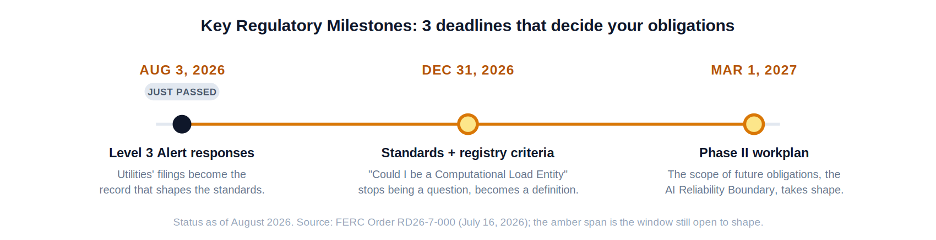
The category exists, and the population and obligations are being decided over the next eight months, partly on the record that entities are creating right now. Distance is no exemption: the related NERC alert already reaches utilities that could merely receive an interconnection request within two years. This is the last stretch in which the people affected can shape the rule instead of simply inheriting it.
What should I be asking right now?
The category reaches three kinds of leader, and each has a different set of questions to answer this quarter. Find the group you belong to and start there.
If you run the computing facilities:
Do we cross the proposed line, at least 1 MW of IT load inside a 20 MW connection at 60 kV or above, at any of our sites?
Could our facility ride through a normally cleared fault today, or would it trip offline and stay there?
Who inside our company would own a federal reliability registration if one landed, and do they know it is coming?
If you are the utility, transmission owner, or load-serving entity:
Which of our current and prospective customers would become Computational Load Entities under the December 31 criteria?
Can we model these loads separately from ordinary industrial load, and do we have the fault recording and telemetry to actually see them?
Could we reach one of these loads in real time and have an instruction followed, by voice or by SCADA?
If you lead AI or security governance:
Do we know where our compute intersects our existing reliability and CIP obligations, and who owns that boundary internally?
If a workload decision becomes a reliability attribute, which function owns it, security, grid compliance, or AI governance?
Does our FY2027 budget already carry the monitoring, protection, and control investments this order makes hard to defer?
Whichever group you are in, the common thread is time. Working out whether your facilities or customers fall inside the new category, and where the gaps sit, costs far less now, while the criteria are still being written, than after the standards are adopted and the deadlines go live. If your team cannot answer these questions with confidence yet, mapping that gap against the December 31 and March 1 milestones, in language a board will read, is the kind of work we do at Ampyx Cyber.
This is the anchor piece for the AI Reliability Boundary series. Later pieces go deeper on the registry criteria, the standards themselves, and the security questions that follow registration.
Follow the series. The next installment breaks down the registry criteria: who lands inside them, and how to get ahead of the December 31 filing. Check back soon, or subscribe to get each installment as it publishes.
Sources and further reading
FERC order directing NERC to file reliability standards and registry criteria for computational load integration, Docket No. RD26-7-000, 196 FERC ¶ 61,031 (issued July 16, 2026): NERC newsroom summary and POWER Magazine coverage.
NERC proposed Rules of Procedure defining the Computational Load Entity and the 1 MW / 20 MW / 60 kV registration thresholds: NERC Computational Load Entity summary of changes (April 2026) and Steptoe analysis.
NERC, Level 3 Essential Action Alert on Computational Load Modeling and Study (May 2026).
NERC, Characteristics and Risks of Emerging Large Loads (white paper), the source for the 1.9 p.u./second ramp and the 450 MW to 40 MW decline.
NERC, Incident Review: Considering Voltage-Sensitive Crypto Load Reductions, the source for the 26 ERCOT ride-through events and the 17 to 95 percent range.
NERC, 2026 State of Reliability report, naming large loads a growing source of frequency and voltage instability.
ERCOT, Large Load Interconnection Status Update (April 9, 2026), roughly 410 GW of large-load requests as of March 26, 2026; see also RTO Insider coverage.
U.S. Energy Information Administration, ERCOT record hourly peak of 91.1 GW on July 22, 2026.
NERC, Project 2026-02 Computational Loads (standards under development).
Ampyx Cyber, FERC Order RD26-7-000: Computational Load Registration and Standards Deadlines (link to the companion Ampyx post).