NERC MSPP Rules of Procedure: Standards Committee Retired in May 2026 Draft
By Patrick Miller
NERC's May 2026 draft Rules of Procedure revisions retire the Standards Committee, eliminate ballot pools, restructure the Registered Ballot Body, and create a new Reliability Standards Body under the RISC. The MSPP Task Force implementation package is the most consequential governance change to NERC standards development since the ERO model was certified in 2006. Comments due June 17, 2026.
Overview
On May 18, 2026, NERC posted preliminary draft revisions to the Rules of Procedure that would implement the Modernization of Standards Processes and Procedures (MSPP) Task Force recommendations accepted by the NERC Board on February 12, 2026. The informal comment window runs through June 17, 2026, with a virtual stakeholder forum on June 25, 2026 and a formal 45-day comment period likely in July or August 2026.
This is not a cleanup pass. The proposal retires the Standards Committee as an independent elected body, eliminates ballot pools, restructures how projects are initiated and prioritized, consolidates Registered Ballot Body segments, retires Appendix 3B in its entirety, and raises the bar on who can propose changes to the Standard Processes Manual itself. If approved on the timeline NERC has sketched, the standards process most North American practitioners learned over the last two decades will look materially different by mid to late 2027 at the earliest.
We covered the Board's February acceptance of the underlying recommendations in Redesigning the Machine: NERC Board Accepts Transformational Standards Modernization Plan. That post explained what the Task Force was proposing and why. This post covers what NERC has actually put on paper to implement those recommendations, where the regulatory text matches the recommendations cleanly, and what remains deferred to governance documents that have not yet been drafted.
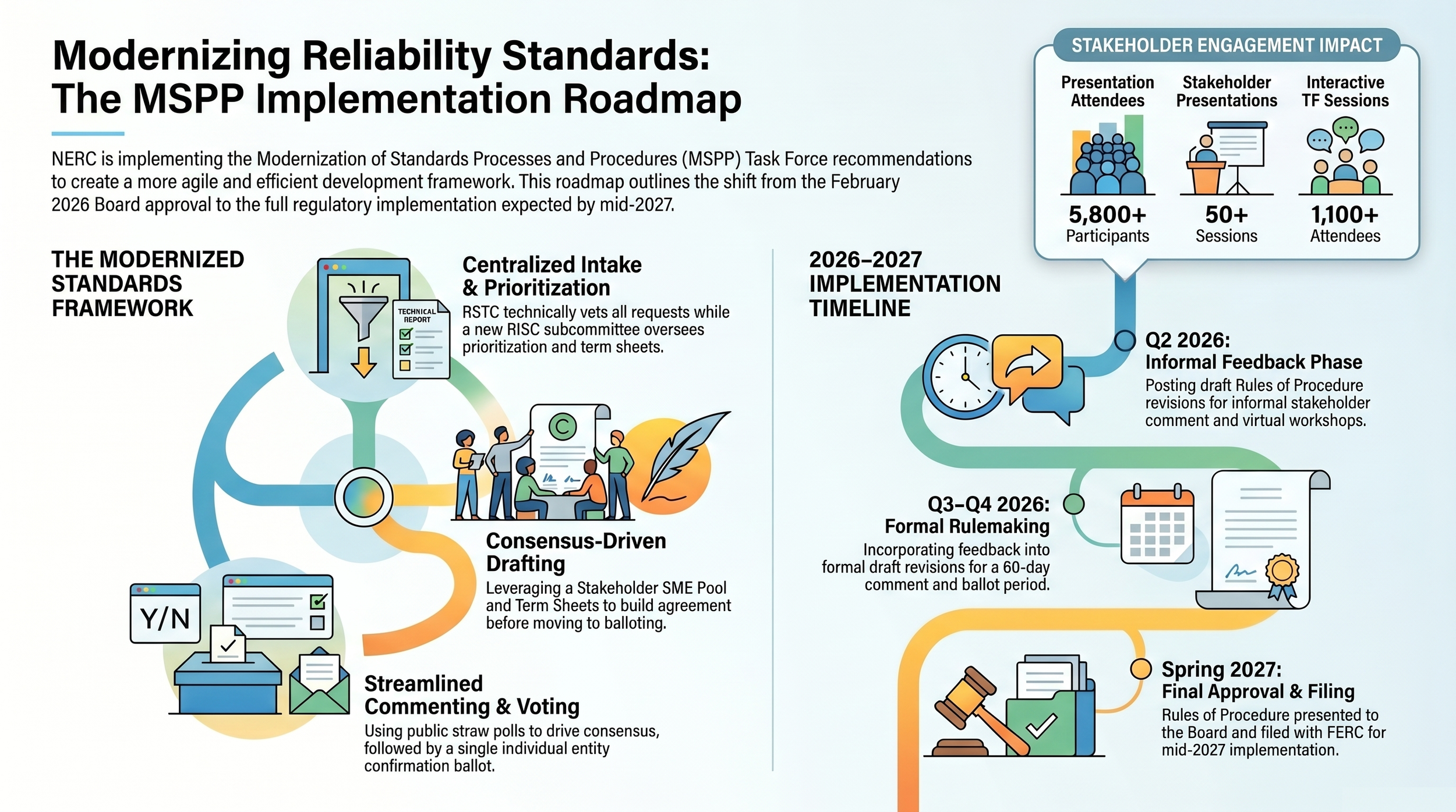
The Five Structural Moves
The May 2026 draft makes five structural moves at the same time. None of them stand alone.
| Move | What It Does | Where It Lives |
|---|---|---|
| Retire the Standards Committee | Replaces an elected, segment-based, process-focused committee with a new appointed and elected subcommittee under the RISC | Section 306 (renamed Reliability Standards Body); Appendix 3B retired entirely |
| Eliminate ballot pools | Ends the practice of forming a fixed pool at the start of a project; voting eligibility now tied to having commented on a term sheet or draft | Section 308; SPM Sections 4.0 and 4.11 |
| Standard Initiation Request intake | All projects, including periodic reviews and interpretations, enter through a semiannual prioritized intake process administered by NERC staff, vetted by the RSTC, and prioritized by the RISC subcommittee | SPM Section 4.1; charters for RSTC and RISC |
| Consolidate Registered Ballot Body segments | Segment 5 absorbs Segment 6 (and demand-side management providers); Segment 7 absorbs Segment 8; Segment 9 restructured; FRCC named into Segment 2; Regional Entities removed from the RBB | Appendix 3D |
| Raise the threshold for proposing SPM revisions | Replaces "any person or entity" with the Section 1401 threshold (fifty Members from at least three Sectors, the MRC, a relevant NERC committee, or a NERC officer) | SPM Section 13.0 (former 15.0) |
The headline of the package is the first move. The Standards Committee has been the elected stakeholder body shepherding the standards process since the ERO was certified in 2006. Retiring it is the most consequential governance change to the NERC standards machinery in twenty years.
The Reliability Standards Body
The proposal defines a new term in Appendix 2: Reliability Standards Body, referring to whichever standing committee or subcommittee the Board designates to provide high-level, strategic oversight of standards development. In practice this body will be a new subcommittee of the RISC, known as the Reliability Standard Development Subcommittee. Appendix 3B, which currently contains the Standards Committee election procedure, is retired alongside the committee itself.
Composition tracks the Task Force recommendation. Fifteen members total: two RISC members serving as chair and vice chair, eleven sector representatives elected from a qualified nominee pool covering NERC Membership Sectors 1 through 10 and 12 as defined in the NERC Bylaws, and two at-large members appointed from either the RISC or the nominee pool. Canadian representation is required to be equitable. The Board appoints all members, including elected members, and all members serve at the pleasure of the Board.
Three features of this structure represent a real shift from how the Standards Committee operated.
The Reliability Standards Body is a subcommittee, not a standing committee. It reports to the RISC, with the RISC retaining approval authority over the Standard Initiation Request Review and Prioritization Reports the subcommittee produces. The RISC charter is itself being revised to expand its scope to include strategic oversight of standards development. The RISC Purpose statement is also being narrowed by striking a phrase that previously authorized RISC to recommend "the use of solutions other than the development of new or revised reliability standards." That phrase is gone. Whether that narrowing is meaningful in practice will depend on how the new subcommittee handles requests that should resolve through non-standards mechanisms.
The Membership Sectors used to elect representatives are the corporate membership sectors defined in the NERC Bylaws, not the Registered Ballot Body segments used to vote on standards. The current Standards Committee elections are run on RBB segments. The new subcommittee elections will run on membership sectors. The two structures cover overlapping but not identical populations, and the political math of who can run for and elect a sector representative will shift.
Composition, election mechanics, term lengths, and reporting structure all live in governance documents (the RISC charter and a new subcommittee scope document) rather than in the Rules of Procedure themselves. NERC's stated reason is to preserve flexibility. The practical effect is that several substantive governance questions, including the qualified nominee pool criteria, term staggering, and the conflict-of-interest framework, will be resolved through processes other than the formal Rules of Procedure revision that is the focus of this comment window. That choice trades procedural protection for flexibility, and it is worth being explicit about.
The Term Sheet: The New Center of Gravity
The most consequential procedural innovation in the package is the Reliability Standard Term Sheet. This is a new document that did not previously exist in NERC's process.
A term sheet is prepared by NERC staff, advised by stakeholder subject matter experts, before any actual standard drafting begins. It describes the reliability risk the project would address and outlines the basic elements of the standard: proposed standard family, purpose, applicability, and a high-level description of requirements. It is the equivalent of a business term sheet that sets out major terms before contract drafting starts.
The term sheet is posted for at least one informal comment period accompanied by a straw poll. The drafting team is not required to respond in writing to the comments received. When the comments and straw poll responses suggest stakeholder consensus on the approach, the Reliability Standards Body authorizes the project to enter the formal comment and ballot process. If consensus on a term sheet is not reached, the project can be paused, ended, or referred for non-standards alternatives.
This single structural choice does a lot of work. It shifts substantive stakeholder engagement from the back end of the process (the ballot) to the front end (the term sheet). It creates a procedural off-ramp for projects that cannot find consensus before significant resources have been invested. And it makes the term sheet, not the draft standard, the document where the most contested decisions actually get made.
The implication for any entity that participates in standards development is direct. Under the new process, if you wait until the formal draft posts to engage, you will have missed the point at which the substantive direction was set. Commenting on a term sheet also counts toward eligibility to vote on the final standard. Not commenting at the term sheet stage and not commenting on any subsequent draft means losing the ability to vote at the confirmation ballot.
Ballot Pools Are Gone. Here Is What Replaces Them.
Under the current process, voting on a NERC Reliability Standard requires joining a ballot pool that is formed during the first 30 days of the initial formal comment period. Once that window closes, the pool is fixed. New members cannot join. The pool then conducts a series of initial and additional ballots as the draft is revised, followed by a final ballot.
The May 2026 draft eliminates all of this. There is no ballot pool. There is no initial or additional ballot. There is no quorum requirement. The mechanics that replace them work as follows.
| Element | Current Process | Proposed Process |
|---|---|---|
| Voting body | Ballot pool formed at start of project | Active RBB members who commented during development |
| Number of ballots | Multiple iterative ballots | A single confirmation ballot |
| Eligibility trigger | Joining the ballot pool during the first 30 days of initial comment | Submitting comments on the term sheet or any prior draft |
| Quorum | At least 75% of ballot pool must respond | None |
| Voting positions | Affirmative, Negative, Abstain | Affirmative, Affirmative with Statement, Negative with Statement |
| Approval threshold | Two-thirds weighted segment majority | Two-thirds weighted segment majority (unchanged) |
| Ballot window | Last 10 days of comment period | At least 10 days, longer permitted |
| NERC facilitation during ballot | Prohibited | Permitted, with neutrality required (no campaigning) |
| Failed ballot | Drafting team revises and reballots | Extraordinary ballot at RISC subcommittee discretion, or project ends |
The move from multiple iterative ballots to a single confirmation ballot is the design feature that makes the whole package work. The Task Force's diagnosis was that the current process treats balloting as the primary driver of consensus, when balloting is actually a poor consensus-building tool. The qualitative work of building consensus happens through comments. The new process moves the qualitative work to the front (term sheet and comment periods on drafts) and reserves balloting for the final confirmation that consensus has, in fact, been reached.
Three features of the new ballot mechanics deserve specific attention. There is no "Negative" vote without a statement, and perfunctory statements like "I disagree" will not satisfy the requirement. There is no "Abstain," which removes the procedural way for a registered voter to register presence without taking a position. And NERC can now facilitate discussion during the ballot window, hosting educational webinars and Q&A sessions provided NERC remains neutral and does not campaign for an outcome.
The Registered Ballot Body Restructure
Appendix 3D is being substantially restructured. The headline changes consolidate segments, name specific entities, and tighten the affiliate and qualification rules.
| Segment | Current | Proposed |
|---|---|---|
| 1 - Transmission Owners | Unchanged | Unchanged |
| 2 - RTOs/ISOs | 8 members, cannot reach full weight | FRCC named into segment; full weight achievable with at least 8 voters |
| 3 - Load-Serving Entities | Unchanged | Unchanged (consolidation with Segment 4 considered and rejected) |
| 4 - Transmission-Dependent Utilities | Unchanged | Unchanged (clarified: "primarily" means 51% or greater) |
| 5 - Electric Generators | Separate from Segment 6 | Absorbs Segment 6 and demand-side management providers |
| 6 - Brokers/Aggregators/Marketers | Independent segment | Retired (reserved) |
| 7 - Large Electricity End Users | Separate from Segment 8 | Absorbs Segment 8; restriction against electric industry entities joining as small users carried forward |
| 8 - Small Electricity End Users | Independent segment | Retired (reserved) |
| 9 - Federal/State/Provincial/Other Governmental | Includes entities with ERO oversight authority | Excludes governmental authorities with ERO oversight authority; NYSRC named; nonprofit public interest entities included |
| 10 - Regional Entities | Independent segment | Retired (reserved); Regional Entities now considered part of the ERO Enterprise voice |
The net effect is a move from ten active segments to six. Under the new weighting math, each active segment can represent up to 14.93% of the total weighted vote, up from 12.05% under the current ten-segment structure. That is not a small change. A single segment can now carry more weight in the formula, which matters for any standard where segment interests align or diverge in identifiable ways.
The Task Force initially proposed consolidating Segments 3 and 4 into a single Load-Serving Entity segment. Stakeholder feedback pushed back, particularly from transmission-dependent utilities. The Task Force withdrew that consolidation in February 2026. The May 2026 draft confirms it. The Task Force did recommend that NERC review the criteria again two years after implementation and consider whether mutual exclusivity between Segments 3 and 4 would be appropriate.
A few procedural changes in Appendix 3D round out the package. The requirement that each segment membership be represented by a different individual is removed, allowing corporate entities more flexibility in how they designate voters. Appeals of NERC staff determinations on segment eligibility now route to the CEO rather than first to the Standards Committee and then to the Board. The affiliate policy is clarified for state and provincial governmental entities, recognizing that different divisions and commissions of the same government may have rules governing independence.
The Quieter Changes Worth Tracking
Four changes sit below the headline level but are substantive enough to flag.
SPM revision proposals now require Section 1401 support. Currently, any person or entity may propose a revision to the Standard Processes Manual, which then enters the formal comment and ballot process. Under the new rule, only proposers meeting the Section 1400 threshold (fifty Members from at least three Membership Sectors, the MRC, a relevant NERC committee, or a NERC officer) can initiate an SPM revision project. Individual stakeholders can still identify the need for revisions, but they will need to gather one of those groups behind a proposal before NERC will consider it. The bar for individual or smaller stakeholders to drive SPM revisions has gone up.
The Director of Standards becomes the posting readiness and errata arbiter. Under the current process, the Standards Committee determines whether a draft is ready for formal posting and whether post-adoption changes qualify as errata. Under the new process, the Director of Standards makes both determinations, with a right of appeal to the Reliability Standards Body if the project team disagrees. Several procedural checkpoints move from the Standards Committee to NERC staff in this same way.
The Board gets a new waiver authority. The new draft preserves the existing waiver mechanism and adds a provision that the Board may waive any SPM provision for good cause shown, citing field tests or trial periods as one circumstance under which the Board could exercise this authority. The waiver provision cannot be used to waive voting approval requirements.
Interpretations and Periodic Reviews may be retired. NERC is explicitly seeking comment on whether Section 7.0 (Interpretations) and Section 11.0 (Periodic Reviews) should be retired entirely. The rationale is that NERC is no longer ANSI-accredited and therefore has no obligation under ANSI rules to maintain these processes, and that in practice both are uncommonly used because substantive revisions typically address the underlying issues. If retired, the underlying matters would be addressed through the Standard Initiation Request intake process.
AI use in drafting is acknowledged in the SPM but intentionally light. The substantive guardrails will live in NERC policies rather than in regulatory text, on the theory that the technology evolves too rapidly to bake specifics into the rules.
What This Means by Stakeholder
The interlocking nature of the changes makes the impact different for different kinds of stakeholders.
| Stakeholder | What Changes | What to Do |
|---|---|---|
| Responsible Entities (asset owners/operators) | Voting eligibility now requires commenting on term sheet or draft; ballot pools eliminated; voter designation more flexible | Plan to engage at term sheet stage on projects relevant to your operations; review which staff are designated as voters |
| Trade associations | Member comments expressing support for trade association positions count toward voting eligibility for those members | Develop term sheet engagement strategies; remind members about commenting eligibility |
| Smaller stakeholders | Lose direct ability to propose SPM revisions; gain easier voting eligibility; periodic review process may be retired | Build relationships with Section 1401-qualifying entities or committees; engage more actively at term sheet stage |
| Standards Committee members | Committee is being retired | Watch for transition planning details; consider candidacy for the new subcommittee qualified nominee pool |
| Stakeholder SMEs | New Stakeholder SME Pool concept replaces project-specific drafting team appointments; target is approximately 75+ members | Expect open nomination opportunities later in 2026 |
| Regional Entities | Lose distinct RBB segment (Segment 10 retired) | Engagement shifts to ERO Enterprise channels |
| End user representatives | Combined Segment 7; restriction against electric industry entities joining as small users carried forward | Outreach for under-subscribed end user representation expected |
| Canadian entities | Equitable representation required; provincial governmental entities without ERO oversight authority continue voting in Segment 9 | Watch the subcommittee scope document for specifics |
Where Stakeholders Pushed Back
While the Modernization of Standards Processes and Procedures (MSPP) effort has garnered support for its overall goals, stakeholder feedback during the drafting process revealed several controversial aspects and areas of mixed opinion. The most debated changes include:
Replacing the Standards Committee with a RISC Subcommittee: There were mixed opinions regarding the proposal to dissolve the legacy Standards Committee and replace it with a new subcommittee under the Reliability Issues Steering Committee (RISC). Some stakeholders argued that the Standards Committee should be maintained with a refreshed mandate, while others questioned whether the RISC, which consists of executive-level members, was the appropriate body to oversee standard development.
Shifting to the "Stakeholder SME Pool": The move away from traditional standard drafting teams in favor of a pre-vetted Stakeholder Subject Matter Expert (SME) Pool drew divided feedback. Opponents argued the existing drafting team model was more efficient for addressing the specific needs of individual projects. They expressed concerns that a standing SME pool might overburden its participants, lack the specific expertise required for nuanced projects, or inadvertently exclude smaller entities that lack the resources to commit an expert to a full term on the panel.
Tying Voting Eligibility to Comment Participation: The proposal to require stakeholders to actively participate in at least one comment period before they are eligible to vote on a final standard received mixed reactions. While the Task Force believes this will force earlier and more substantive engagement, stakeholders raised concerns about how this participation would be tracked and whether entities signing onto trade association comments would still be allowed to vote.
Consolidating Registered Ballot Body (RBB) Segments: Stakeholders generally opposed proposals to simplify and consolidate the RBB voting segments. There was significant concern that combining segments would dilute specific industry perspectives, impact minority representation, or give a handful of entities disproportionate influence. For example, strong pushback caused the Task Force to abandon its proposal to consolidate Load-Serving Entities (Segment 3) and Transmission-Dependent Utilities (Segment 4).
Voter Attestations and the Removal of Ballot Pools: Stakeholders pushed back against a proposal that would require voters to attest that they are authorized to represent their company's position before every ballot, leading the Task Force to drop the requirement. Furthermore, stakeholders were split on the decision to move away from forming dedicated ballot pools and eliminating quorum requirements for confirmation ballots.
Skepticism Over "Process Efficiencies": Some stakeholders directly disagreed with the premise that the new process would be more efficient or provide sufficient opportunities for input. There were concerns that forcing consensus-building into the very early stages of initiation could limit opportunities to fully assess the financial, operational, or regulatory impacts of a proposed standard.
The Use of AI in Drafting: There are mixed perceptions among stakeholders regarding the use of Artificial Intelligence as an effective tool for drafting standards or summarizing comments. Stakeholders universally emphasized that AI should only be used as a tool with strict guardrails and rigorous human oversight, rather than as a replacement for human-led drafting
Open Questions Going Into the Comment Period
Four questions (and probably more, but let’s start with these) are genuinely open and worth raising during the comment window.
Does moving governance details out of the Rules of Procedure into committee-approved documents weaken stakeholder protections? This is the question underneath several of the changes. The federally approved Rules of Procedure carry more procedural weight than committee-approved documents. Stakeholders who care about preserving the current level of procedural protection for subcommittee composition, election mechanics, and SME pool selection have a window to argue for keeping those elements in the Rules of Procedure rather than in lower-protection governance documents.
Is the term sheet engagement timing realistic for stakeholders with limited resources? The new process front-loads stakeholder engagement to the term sheet stage. The Task Force's argument is that this is more efficient overall. The counter-argument is that front-loaded engagement assumes resources that smaller entities and minority interest representatives may not have. Implementation will hinge on whether NERC and the Reliability Standards Body actively work to ensure term sheet engagement is accessible, or whether the new structure ends up favoring entities with the resources to engage early and often.
How will the criteria and risk model for prioritization actually work? The new process depends heavily on consistent criteria and a risk model for vetting Standard Initiation Requests and prioritizing them. Those criteria do not yet exist. NERC has committed to developing them through an open and transparent process and posting them publicly, but the timing and substance are not in the regulatory text. The substance of these criteria will determine, in practice, which reliability risks get standards and which get alternatives.
Will the Interpretations and Periodic Review sections be retired? NERC is explicitly seeking comment on this question. Retiring both sections would simplify the SPM and align with NERC's post-ANSI status. It would also eliminate two procedural pathways that, even if rarely used, exist as stakeholder-accessible mechanisms for raising questions about existing standards.
The Comment Window
| Date | Event | Action |
|---|---|---|
| May 18, 2026 | Informal comment period opens | Review the preliminary draft and the annotated Task Force recommendations |
| June 17, 2026 | Informal comment period closes | Submit informal comments through nerc.com |
| June 25, 2026 | Virtual stakeholder input forum | Attend virtually or submit additional feedback |
| July or August 2026 (estimated) | Formal comment period begins (45 days minimum) | Submit formal comments through the formal Rules of Procedure revision process |
| Later in 2026 | Standing committee charter revisions through committees and to NERC Board | Track through RSTC and RISC channels |
| Mid-2027 (target) | Board approval and FERC filing | Track Board materials and the FERC docket |
| Mid to late 2027 (earliest) | Implementation begins | Watch for transition plan details |
The informal comment period is the window when foundational design questions are most easily moved. The formal comment period that follows is the window when specific regulatory text gets refined. Stakeholders with structural concerns should comment now. Stakeholders with line-level drafting concerns can comment now or wait for the formal window. The June 25 forum is an opportunity for direct dialogue with NERC staff and the MSPP Task Force.
Forward Thought
The MSPP package is the most consequential reorganization of how NERC develops Reliability Standards since the ERO model itself was certified in 2006. The diagnosis behind it is correct. The current process struggles to keep pace with risks that emerge faster than two-year standards cycles. The Section 321 invocations in August 2024 and January 2025, two events in six months after the authority sat unused for over a decade, are the data points that motivated the Board to act.
Several of the design choices in the package trade procedural protection for flexibility. The argument for those trades is that flexibility is what the moment requires. The argument against is that procedural protection is what gives stakeholders confidence that the process is fair when the substantive outcomes are contested. Both arguments are real. The right time to weigh them is during the comment period that is open now.
Two things are worth holding on to as the process moves forward. The first is that this is implementation, not approval. The Board acceptance has already settled the direction. The window now is about how the direction translates into rules. The second is that the document NERC posted on May 18 is preliminary. Substantive changes between the informal and formal versions are expected. Comments submitted now have the most leverage they will have in the entire process.
The standards process we have built over the last two decades has worked. It has also, increasingly, struggled. The MSPP proposal is the most serious attempt in a generation to address that struggle. The comment window is open. Engage early, engage substantively, and watch the documents that are being deferred to governance.
![One Incident, Several Reports: What GAO's Panel & CISA's Town Halls Say About Harmonization [Updated]](https://images.squarespace-cdn.com/content/v1/5f80bdfaeeac37068ed8c60e/1785335419831-X41D7GN7VRFMIJ472YFX/Policy+Pulse.png)